


Last Updated July 17, 2026
The first Greek phrase I ever learned wasn’t exactly useful for ordering at a restaurant. It was: Ta manitaria einai sto psygeio. The mushrooms are in the fridge. I repeated it to every Greek friend I had, so proud of myself. Everyone laughed, because it was just so absurd. But I’d learned it by heart, and I had to use it somewhere!
I was lucky enough to learn Greek in a rather unusual way. My mum is a classical Greek teacher, and she’s always kept in touch with a Greek friend of hers who teaches French in Athens. It was she, whom I see as a second mum very dear to my heart, who introduced me to modern Greek when I was living in Greece. Two language teachers, a whirlwind of dictionaries and laughter, and one girl repeating phrases about mushrooms. Quite the setup!
The truth is, in Greece, practically everyone speaks English, especially in tourist areas. You can travel without learning a single word of Greek and get along perfectly well. But that’s not really the point.
The point is what happens when you try. The waiter’s face changes. The old lady at the market suddenly becomes chatty. The barman sets a complimentary glass of tsipouro on the counter. Those little moments can’t be bought, and they almost always start with a kalimera said with a slightly awkward smile!
This Greek travel phrases guide brings together the words and expressions that are actually useful on a trip, organised by real-life situation. The Greek alphabet might look intimidating at first glance, but it only has 24 letters and you can crack it quickly with a little practice. Phonetic pronunciation is included throughout so you can read every phrase without knowing the alphabet!
This article contains affiliate links. If you book through my links, I earn a small commission at no extra cost to you. Thank you for supporting The Beach Muse!
Greek pronunciation: the basics in 2 minutes
Before you dive in, here are the sounds that tend to trip up English speakers.
In the phonetic transcriptions below, the syllable in bold is the one you naturally stress when you speak, think of it like the beat of the word. In Greek, this stress can fall anywhere in a word, not necessarily at the end, which is why it’s worth paying attention to from the start!
The “y” sound in Greek is like the “y” in “yes”. Yeia sas is pronounced “yah-sas”.
The “ch” sound doesn’t really exist in Greek. The closest equivalent is a slightly aspirated “h”, a bit like the Spanish jota. You’ll hear it in efharisto (thank you) and horis (without). It also has a second pronunciation that sounds a bit like the “ch” in the German word ich (or kind of like a cat that’s hissing haha!), you’ll definitely hear it in Greece!
The “r” is rolled slightly, closer to Spanish or Italian than English.
The “g” before “e” or “i” is often pronounced like “y”: gyros is “yee-ros”, not “jai-ros”. That’s why Greeks smile when tourists order a “jai-ros”!
The “d” in Greek is often closer to the English “th” as in “the”. So den (not) sounds like “then”.
And the good news: Greeks are incredibly forgiving when it comes to pronunciation mistakes. Even with a heavy accent, the effort is always noticed and appreciated!
Greetings and politeness
These are the words you’ll use from day one, in every interaction. Genuinely worth learning before you go!
Good morning (morning and early afternoon)
Καλημέρα / Kalimera / “kah-lee-mé-rah”
The universal greeting for the first part of the day. In Greece, it’s used until around 2pm. It’s often the first Greek word people learn!
Good evening (from around 2pm)
Καλησπέρα / Kalispera / “kah-lee-spé-rah”
Worth knowing for the long terrace evenings that start late in Greece. Dinner at 10pm is completely normal!
Hello (informal) / Goodbye
Γεια σας / Yeia sas / “yah-sahs” (formal, to multiple people or someone you don’t know)
Γεια σου / Yeia sou / “yah-soo” (informal, to a friend or someone younger)
Yeia sas and yeia sou work for both hello and goodbye, like “ciao” in Italian! You can say yeia sas when walking into or out of a shop.
Good night
Καληνύχτα / Kalinikta / “kah-lee-nih-ktah”
Thank you
Ευχαριστώ / Efharisto / “ef-hah-ree-stó”
Probably the most important word in this entire Greek phrasebook for tourists! Greeks always notice it. Make a habit of adding it to the end of every interaction. To thank someone warmly, add poli: Efharisto poli (thank you very much).
Please / You’re welcome
Παρακαλώ / Parakalo / “pah-rah-kah-ló”
Parakalo pulls triple duty: it means “please” when making a request, “you’re welcome” when someone thanks you, and sometimes “sorry?” when you didn’t catch something. One word, three uses!
Excuse me / Sorry
Συγγνώμη / Signomi / “see-gnó-mee”
To get someone’s attention, apologise for bumping into someone, or start a question with a stranger.
Yes / No
Ναι / Nai / “neh”
Όχι / Ochi / “ó-hee”
The classic trap: nai means “yes” in Greek! If a Greek nods and keeps saying “nai nai nai”, they’re agreeing with you, not refusing. The Greek head movement for “no” can also throw you off: a slight backward tilt of the head, sometimes with a little click of the tongue.
Nice to meet you
Χαίρω πολύ / Hero poli / “hé-ro poh-lí”
At the end of a meeting: Χάρηκα πολύ / Harika poli / “há-ree-kah poh-lí” (Lovely to have met you)
What’s your name?
Πώς σε λένε; / Pos se lene? / “pos seh lé-neh?”
To address someone older or someone you’ve just met, use the formal version: Pos sas lene?
My name is…
Με λένε… / Me lene… / “meh lé-neh…”
I don’t understand
Δεν καταλαβαίνω / Den katalaveno / “then kah-tah-lah-vé-no”
Do you speak English?
Μιλάτε αγγλικά; / Milate anglika? / “mee-lá-teh ahn-glee-ká?”
Could you repeat that?
Μπορείτε να επαναλάβετε; / Borite na epanalavete? / “boh-rí-teh nah eh-pah-nah-lá-veh-teh?”
Could you speak more slowly?
Μπορείτε να μιλήσετε πιο αργά; / Borite na milisete pio arga? / “boh-rí-teh nah mee-lí-seh-teh pyo ar-gá?”
See you later / Bye
Τα λέμε / Ta leme / “tah lé-meh” or Ta leme meta
A very natural, very Greek way to wrap up a conversation. You’ll hear it constantly!
At the restaurant and café
So much of life in Greece happens around a table. Meals go on for a long time, portions are generous, and waiters expect you to take your time. Here are the basic Greek phrases for tourists that’ll get you through any meal without stress!
The menu, please
Το μενού, παρακαλώ / To menou, parakalo / “to meh-noú pah-rah-kah-ló”
I’d like…
Θα ήθελα… / Tha ithela… / “thah í-theh-lah…”
We’ll have…
Θα πάρουμε… / Tha paroume… / “thah pá-roo-meh…”
Enjoy your meal!
Καλή όρεξη / Kali orexi / “kah-lí ó-reh-xi”
Water, please
Νερό, παρακαλώ / Nero, parakalo / “neh-ró pah-rah-kah-ló”
In Greece, tap water isn’t always brought to the table automatically. Don’t hesitate to ask! If you want sparkling water, the word is ανθρακούχο νερό / anthrakoúkho neró, but you can simply ask for σόδα / só-da and everyone will understand.
Cheers!
Στην υγειά μας! / Stin yeia mas! / “steen yiá mahs”: literally “To our health”
Shorter, more casual version: Γεια μας! / Yamas! / “yá-mahs”
To toast a specific person: Stin yeia sou (to your health) or Stin yeia sas (formal).
A coffee, please
Ένα καφέ, παρακαλώ / Ena kafe, parakalo / “é-nah kah-fé pah-rah-kah-ló”
Greek coffee (ellinikos kafes) comes in three versions: sketo (no sugar), metrio (medium sweet) or gliko (sweet). It arrives in a small cup and is meant to be sipped slowly. Don’t drink the last sip, it’s grounds!
Useful Greek food vocabulary
- Chicken: κοτόπουλο / kotopoulo / “koh-tópoo-lo”
- Pork: χοιρινό / hirino / “hee-ree-nó“
- Fish: ψάρι / psari / “psáree”
- Bread: ψωμί / psomi / “pso-mí“
- Red wine: Κόκκινο κρασί / kokino krasi / “kókee-no krah-sí“
- White wine: Λευκό κρασί / lefko krasi / “léfko krah-sí“
- Beer: Μπύρα / bira / “bírah”
- Without meat: χωρίς κρέας / horis kreas / “hoh-rís kréas”
- Vegetarian: χορτοφάγος / hortofagos / “hor-toh-fágos”
- I’m allergic to…: Είμαι αλλεργικός/ή σε… / Ime alergikos/i se… / “ímeh ah-ler-gee-kós/ee seh…”
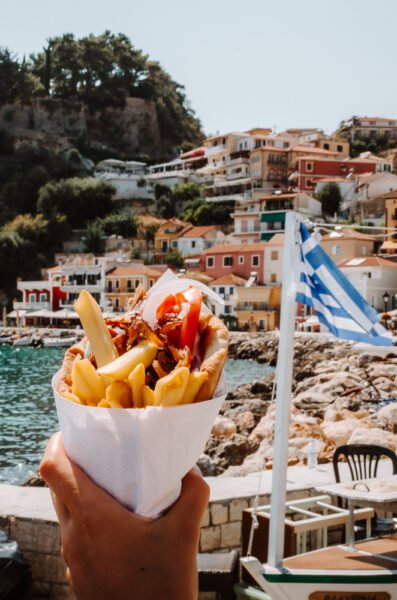
Ordering a souvlaki or gyros
Γεια σας, θα ήθελα ένα σουβλάκι / μια πίτα γύρο με κοτόπουλο / χοιρινό, ντομάτα, κρεμμύδι, πατάτες και τζατζίκι / γιαούρτι
Yeia sas, tha ithela ena souvlaki / mia pita gyro me kotopoulo / hirino, domata, krimidi, patates ke tzatziki / yaourti
Hello, I would like a souvlaki / a gyros with chicken / pork, tomato, onion, french fries and tzatziki / yoghurt
This full phrase lets you order Greece’s most iconic street food without any confusion. Souvlaki is grilled skewers. Pita gyro is the rotating meat wrapped in flatbread. Both are excellent — you really can’t go wrong!
Find out the difference between gyros, souvlaki and kebab in Greece →
The first time I tried ordering in Greek at a restaurant, I wanted to impress my friends. I’d mentally rehearsed my order at least three times. The waiter answered in fast, perfect Greek and I understood absolutely nothing. But I smiled. He smiled. And the right order arrived. Sometimes that’s all it takes, just go for it!
Where are the toilets?
Πού είναι η τουαλέτα; / Pou ine i toualeta? / “poo í-neh ee too-ah-lé-tah?”
The bill, please
Το λογαριασμό, παρακαλώ / To logariasmo, parakalo / “to lo-gah-ree-az-mó pah-rah-kah-ló“
Getting around: ferries, buses, taxis
Greece often means juggling multiple modes of transport, especially if you’re island hopping. These Greek travel phrases will save you from some unpleasant surprises!
Where is…?
Πού είναι…; / Pou ine…? / “poo í-neh?”
Very versatile. You can point to a map or a name on your phone right after!
I want to go to…
Θέλω να πάω στο/στη… / Thelo na pao sto/sti… / “thé-lo nah pah-ó sto/stee…”
Sto before a masculine or neuter noun, sti before a feminine noun. When in doubt, sto works in most cases.
What time does the ferry leave?
Τι ώρα φεύγει το πλοίο; / Ti ora fevgi to plio? / “tee ó-rah féf-yee to plí-o?”
The port / The bus stop / The airport
Λιμάνι / Limani / “lee-má-nee”
Στάση λεωφορείου / Stasi leoforeiou / “stá-see leh-o-fo-rí-oo”
Αεροδρόμιο / Aerodromio / “ah-eh-ro-dró-mee-o”
How much does it cost?
Πόσο κάνει; / Poso kani? / “pó-so ká-nee?”
Very useful for taxis on the islands where the meter isn’t always running. Always ask the price before you get in!
Planning a trip to Greece? Check out my full Greece travel guide — budget, transport, accommodation and the best destinations!
Stop here, please
Εδώ, παρακαλώ / Edo, parakalo / “eh-dó pah-rah-kah-ló”
Straight ahead / Left / Right
Ευθεία / Efthia / “ef-thí-ah”
Αριστερά / Aristera / “ah-rees-teh-rá”
Δεξιά / Dexia / “deh-xee-á“
Shopping and markets
How much does this cost?
Πόσο κάνει αυτό; / Poso kani afto? / “pó-so ká-nee af-tó?”
Do you have…?
Έχετε…; / Ehete…? / “é-heh-teh?”
Can I try this on?
Μπορώ να το δοκιμάσω; / Boro na to dokimaso? / “boh-ró nah to doh-kee-má-so?”
It’s too expensive
Είναι πολύ ακριβό / Ine poli akrivo / “í-neh poh-lí ah-kree-vó”
Do you have something cheaper?
Έχετε κάτι πιο φθηνό; / Ehete kati pio fthino? / “é-heh-teh ká-tee pyo fthi-no?”
Very beautiful!
Πολύ ωραίο / Poli oreo / “po-lee o-réh-o”
Numbers
Essential for prices, bus numbers and departure times!
1: ένα / ena / “é-nah”
2: δύο / dio / “dí-o”
3: τρία / tria / “trí-ah”
4: τέσσερα / tessera / “tés-seh-rah”
5: πέντε / pende / “pén-deh”
6: έξι / eksi / “ék-see”
7: επτά / epta / “ep-tá”
8: οκτώ / okto / “ok-tó”
9: εννέα / ennea / “en-né-ah”
10: δέκα / deka / “dé-kah”
20: είκοσι / ikosi / “í-ko-see”
50: πενήντα / peninda / “peh-nín-dah”
100: εκατό / ekato / “eh-kah-tó“
Emergencies
Help!
Βοήθεια! / Voithia! / “voh-í-thee-ah”
Call the police!
Καλέστε την αστυνομία! / Kaleste tin astinomia! / “kah-lés-teh teen ahs-tee-no-mí-ah”
Police emergency number in Greece: 100
Medical emergency / ambulance: 166
European emergency number: 112
I need a doctor
Χρειάζομαι γιατρό / Hriazomai yatro / “hree-ah-zó-meh yah-tró”
Fire!
Φωτιά! / Fotia! / “fo-tiá”
I’ve lost my passport
Έχασα το διαβατήριό μου / Ehasa to diavatirio mou / “é-hah-sah to dee-ah-vah-tee-rió moo”
I’ve been robbed
Με έκλεψαν / Me eklepsan / “meh ék-lep-sahn”
At the beach
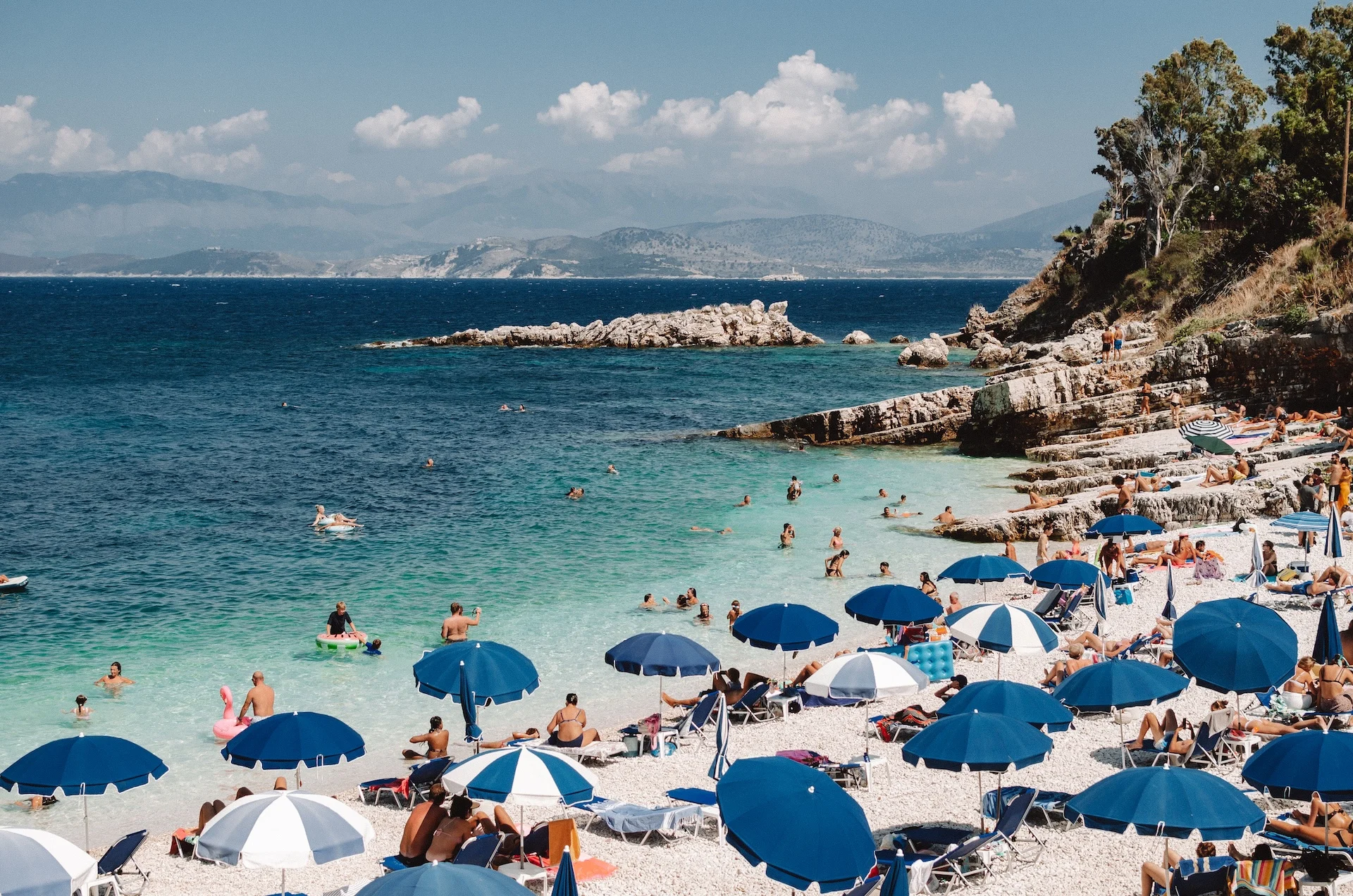
In Greece, the beach is a way of life! Here are the phrases to know for organised beaches, which are very common on the islands.
Can I rent a sun lounger?
Μπορώ να νοικιάσω μια ξαπλώστρα; / Boro na nikiaso mia xaplostra? / “boh-ró nah nee-kee-á-so myah xah-plós-trah?”
Is this a public or private beach?
Είναι δημόσια ή ιδιωτική παραλία; / Ine dimosia i idiotiki paralia? / “í-neh dee-mó-see-ah ee ee-dee-o-tee-kí pah-rah-lí-ah?”
In Greece, all beaches are legally accessible to the public, even those managed by private establishments. But renting a sun lounger is often expected if you settle in the organised area.
Is the water cold?
Το νερό είναι κρύο; / To nero ine krio? / “to neh-ró í-neh krí-o?”
Watch out for sea urchins!
Προσοχή αχινοί! / Prosochi ahini! / “proh-so-hí ah-hee-ní”
Sea urchins are very common on rocky Greek beaches. This phrase could save your feet, or at least get a laugh!
Everyday expressions
None of these words appear in an official Greek phrasebook, but you’ll hear them everywhere. Knowing them, even passively, completely changes the experience!
Ela! / Έλα! / “é-lah”
The magic word of everyday Greek. Depending on context, it means “come”, “come on”, “go ahead”, “keep going” or even “really?”. Answer the phone with a friend: ela. Invite someone in: ela. Cheer someone on: ela ela. If a Greek says ela to you with a big smile, you’re very welcome!
Endaxi / Εντάξει / “en-dá-xee”
“OK”, “alright”, “got it”. Probably the word you’ll hear most often in Greece after kalimera. It confirms, validates, closes a conversation. Endaxi says it all!
Opa! / Ώπα! / “ó-pah”
The quintessential Greek exclamation, expressing surprise, enthusiasm, a small mishap or pure joy. It comes out when glasses clink, when great food arrives at the table, when something goes slightly wrong but no one really minds. If someone says opa to you with a big smile, you’re in the right place!
Siga siga / Σιγά σιγά / “see-gá see-gá“
Literally “slowly slowly”. It’s the Greek philosophy summed up in two words. You say it when someone’s moving too fast, worrying unnecessarily, or not appreciating the moment enough. Gulping down your freddo espresso in two minutes? Siga siga. Ferry three hours late? Siga siga. Endless queue? Siga siga. It’s also the best travel advice anyone can give you for Greece!
Pame! / Πάμε! / “pá-meh”
“Let’s go!” The Greek impulse. Used to get moving, kick off a night out, head to the beach. Contagious by nature!
Telio / Τέλειο / “té-lee-o”
Perfect, great, brilliant. The Greek equivalent of “awesome”. You’ll hear it constantly whenever something nice is confirmed or enjoyed.
Alithia? / Αλήθεια; / “ah-lí-thee-ah?”
“Really?” or “Is that true?”. To express surprise or disbelief, exactly like in English. Very useful for looking engaged in a conversation you’re only 30% following!
Den pirazi / Δεν πειράζει / “then pee-rá-zee”
“No worries”, “it’s fine”, “don’t worry about it”. The standard Greek response to a mistake or a setback. Use it when you spill your coffee or show up late to meet someone!
Bravo / Μπράβο / “brá-vo”
Same as in English, but Greeks use it far more often and in a wider range of situations: praising a child, thanking a street musician, cheering on a friend. Said with great enthusiasm and a rolled r!
File mou / Φίλε μου / “fí-leh moo”
“My friend” (masculine). Koukla mou / “koú-klah moo”: “my doll”, a very common term of affection used with everyone, not just children. Agapi mou / “ah-gá-pee moo”: “my love”, used very naturally between people who know each other well.
Re / Ρε / “reh”
An informal filler word with no direct English equivalent, slipped into the beginning or end of a sentence between friends. A bit like “mate” or “hey”. “Re, ela!” (Hey, come on!). Avoid it with strangers or older people!
Malaka / Μαλάκας / “mah-lá-kahs”
A swear word, but used very casually between close friends in Athens, a bit like how “idiot” can be used affectionately in English. You’ll hear it a lot in informal conversation. Don’t use it yourself, especially with someone you’ve just met!
Ase / Άσε / “á-seh”
“Forget it”, “leave it”, “let it go”. Short, practical, very common. Ase to (leave it). Ase me (leave me alone).
To wrap it up
Learning a language also means learning to accept not understanding everything. In Greece more than anywhere else, the effort counts as much as the result. A kalimera said with good intentions, a sincere efharisto, a smile alongside a slightly clumsy signomi… That’s often all it takes to create a real moment of connection with someone!
The Greek alphabet, once you crack it, brings its own satisfaction. Spotting ΕΞΟΔΟΣ on a sign at the airport and realising it says “exodos” (exit), a word that exists in English too, and in French, and in almost every European language. The links are everywhere, once you start looking for them!
And if you ever want to drop a completely random phrase to impress your friends: Ta manitaria einai sto psygeio. The mushrooms are in the fridge. It’ll be completely useless. But it’ll make everyone laugh!
Take this guide with you
All the Greek travel phrases and basic Greek words in this article fit on a single page, designed to be printed, laminated and slipped into your bag. The printable Greek phrasebook PDF includes all the essential categories with phonetics, numbers, emergencies and cultural expressions to know, even without wifi.
The perfect format for offline moments: in a taxi on an island, on a ferry between destinations, in a taverna off the beaten track. A basic Greek vocabulary PDF that actually fits in your pocket!
Heading to Greece and wondering what to do once you’re there? My Greece Google Maps guides with dozen of tried-and-tested addresses are waiting for you →
Did you like this article? Save it on Pinterest!